Building A Halal Portfolio: What To Know About Sharia-Compliant ETFs
Investing is a key part to everyone’s retirement plan and the earlier you start, the better off you are benefiting from compounding gains. Unfortunately, there is a stigma within some of the Muslim community to save and invest due to lack of knowledge, not widely practiced and the fear that the act of investing is immoral or haram. Though there are more diligence and work needed to make sure you are investing in a halal or acceptable manner, you don’t need to be a dedicated stock trader to benefit from investing and the hope of this article is to give a base introduction to what a solid halal portfolio would look like and something I practice for myself. There are no universal answers so take the advice and as always, take the good from it and implement and anything bad or disliked remove from your actions. There are some stocks that are admissible for Muslims to invest in and some that aren’t. Some of the criteria that a Muslim should follow.
Business Should Be A Permissible (Halal) Business
The business activities should be permissible to Islamic values. This means any business that deals with alcohol, gambling, pork, adult entertainment, weapons and defense spending or drugs like tobacco and cannabis are impermissible. If the company’s main revenue is derived from any of the above activities, then as a Muslim you should refrain from investing. Some examples of non-halal companies include FanDuel (DUEL) due to gambling, Constellation Brands (STZ) due to alcohol, Altria () due to tobacco, and Boeing (BA) or Lockheed Martin (LMT) due to defense and weapons spending. These stocks have made a lot of people a lot of money over the years with tobacco being on of the best income stock plays over the last 30-40 years but are forbidden for Muslim investors.
Another business practice that Muslims should never invest in are companies that make a majority of there money dealing with interest. This means all banks and most financial companies are off the table. For those that are non-Muslim this might seem strange since interest is on of the core staples to investing with bonds and corporate debt investing and working with banks. In Islam, dealing with interest or usury is one of the most severe sins and should be avoided at all costs. This means keeping money in high yield savings accounts, investing in bonds and even keeping money in money markets is not advisable. Any interest that is incurred should be given away with the knowledge it wasn’t wealth you were entitled to earn to begin with.
Financial Structure Should Be Sound And Sustainable
Even if the business practice is halal in nature, the company can operate in a manner that doesn’t comply with Islamic principles. Companies with high debt, hold large interest based assets or have high accounts receivable could be exceeding levels that are not permissible. This is more nebulous with different Shariah boards having slightly different thresholds for stock screening but the main ratios to follow are as shown below.
- Debt Ratio: Total Debt / Total Assets <= 33%
- Interest Related Assets: (Cash + Interest Bearing Assets) / Total Assets <= 33%
- Accounts Receivable: (Accounts Receivable / Total Assets) <= 33%
The above ratios protect Muslim investors from investing in companies that deal with interest indirectly due to large cash reserves in the balance sheet incurring interest, leveraged companies with high debt that need to pay huge interest bills, and limit the reliance of credit sales and other interest related activities.
So What Is The Plan For A Beginner Investor
There are many types of investors so the plan that I outline is not a one size fits all. Individual stock picking is not for everyone and I don’t recommend unless you know what to look for, how to assess risk and benefits as well as bare minimum being able to read a balance sheet, income statement and cash flow statement and understand what everything means. Luckily, there are exchange traded funds (ETFs) that will do the work for you that are shariah-compliant. It is highly advisable to research and make sure you know what you are investing in but here are some index funds that should help you start investing.
Wahed FTSE USA Shariah ETF (HLAL) focuses on large cap US stocks with a heavy focus on technology with over 45% of stocks in the fund being in technology. The yield of 0.56% is almost completely wipe out due to the 0.5% expense ratio so you would invest in this to track the large companies that basically drive the US economy at the moment minus Nvidia (NVDA).
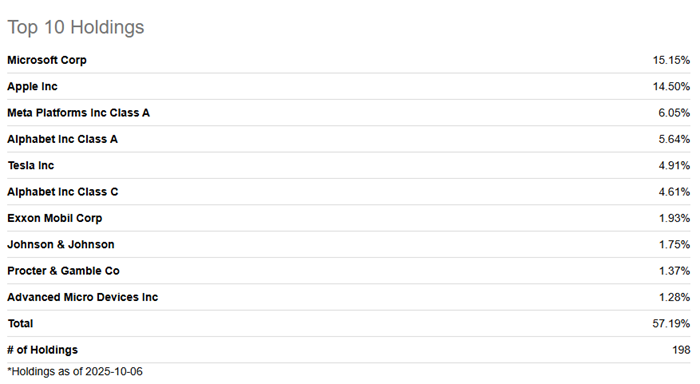
Source: SeekingAlpha Holdings tab
Wahed Dow Jones Islamic World ETF (UMMA) focuses on international large cap stocks. Another fund that reflects the technological age we are currently in with almost 40% of the fund being in technology with almost 16% in Taiwan Semiconductor Manufacturing (TSM) alone. A relatively small dividend yield of 1.05% is lessened due to a high 0.65% expense ratio. This fund gives exposure to your portfolio if you feel it is too US centric and provides some diversification.
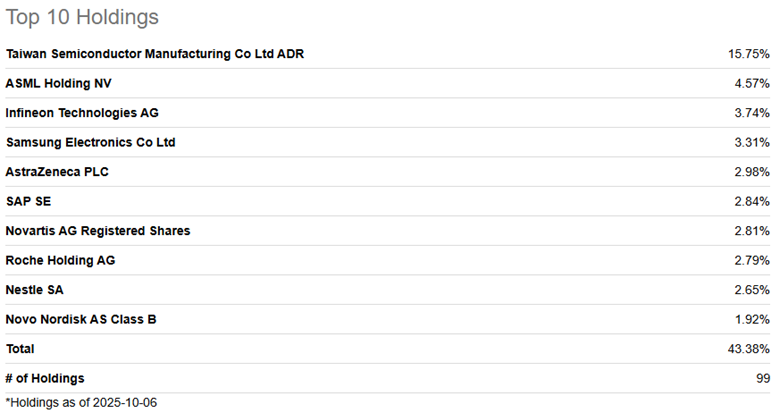
Source: SeekingAlpha Holdings tab
SP Funds S&P Global REIT Sharia ETF (SPRE) focuses on REITs for income with some large REITs including Prologis, Welltower and Equinix. With interest rates dropping, REITS could become more valuable over time so this basket of sharia compliant REITs can boost your portfolio dividend yield and appreciate over time. Currently, SPRE is sporting a 4.21% dividend yield with a 0.5% expense ratio resulting in a 3.71% net yield.
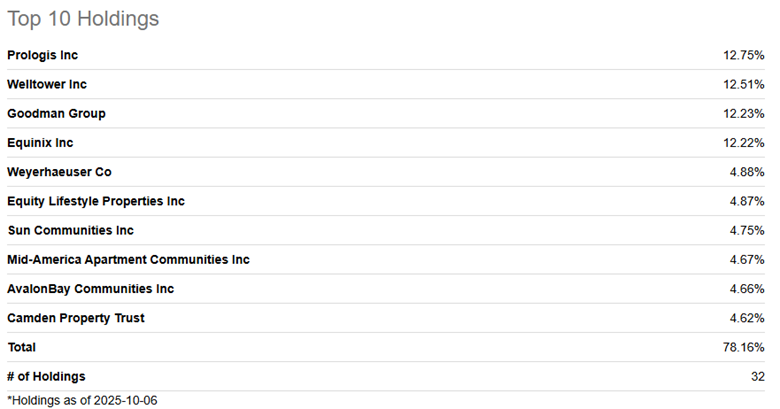
Source: SeekingAlpha Holdings tab
SP Funds Dow Jones Global Sukuk ETF (SPSK) is a global ETF focusing on investing in sukuk. So, what is a sukuk? Sukuk is a financial certificate that represents ownership of a underlying asset or investment and earns profit from its performance. Some people compare this to a bond with the yield provided but the key is that a bond gives an interest rate on the debt while a sukuk shares the profit with ownership like a dividend yield. This ETF carries a 3.41% dividend yield currently and an expense ratio of 0.5%.
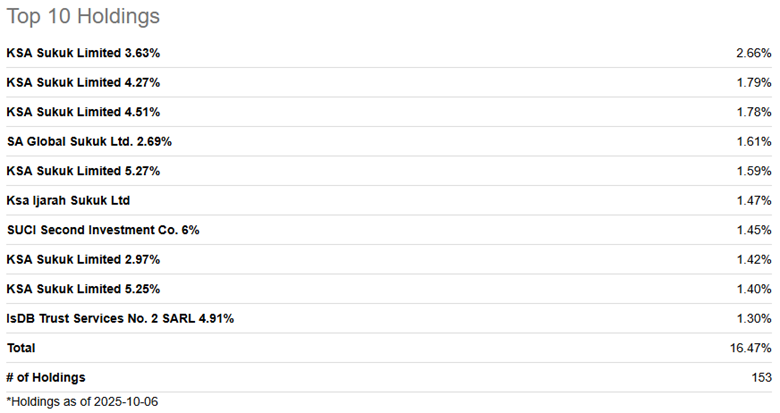
Source: SeekingAlpha Holdings tab
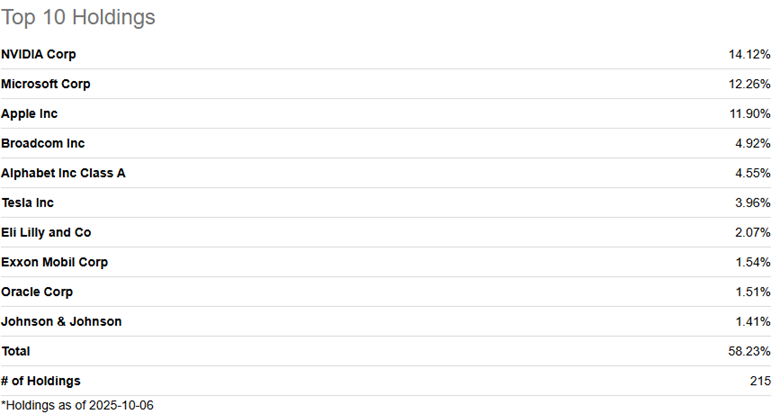
SP Funds S&P 500 Sharia Industry Exclusions ETF (SPUS) focuses on large cap US stocks with a higher focus on technology with the fund almost holding 59% in technology stocks with NVIDIA (NVDA) the largest holding. Dividend yield of 0.6% almost completely wiped out by the 0.45% expense ratio.
Source: SeekingAlpha Holdings tab
Recommendation For Initial Portfolio
My initial recommendation for an initial stock portfolio would be an even split between the 5 ETFs to get some diversification while also benefiting from the technological wave that with AI looks to be continuing for a little while longer.
- 15% HLAL
- 15% UMMA
- 15% SPRE
- 15% SPUS
- 15% SPSK
- 15% Gold
- 10% Silver
You’ll notice that I am also dedicating 25% of the portfolio to gold and silver. Holding cash in money markets and incurring interest is something to avoid but with the uncertainty of the US dollar due to deficit government spending, holding gold and silver long term is a good strategy. This year gold and silver have skyrocketed with 50%+ returns YTD. The two I recommend are Sprott Physical Gold Trust (PHYS) and Sprott Physical Silver Trust (PSLV). Both represent physical gold reserves as opposed to other exchanges that are paper commodities and mirror the asset as opposed to holding the asset. Now, be mindful that the expense ratio for PHYS (0.41%) and PSLV (0.58%) is not cheap. Some alternatives with lower expense ratios for gold include AAAU (0.18%) and GLDM (0.1%) and for silver include SIVR (0.3%).
Now if you want to trade individual stocks and stay away from expense ratios, there are a plethora of websites and apps that have sharia compliant screening so you can check if a particular stock is either halal, questionable or haram to invest in.
Conclusion
In summary, investing is a critical thing to do for everyone including Muslims. While there are more hurdles to go through when investing in a permissible manner to adhere to Islamic laws, the benefits don’t have to be muted. Whether you want to have a basket of ETFs like I shared above or trade individual stocks, Muslims should not feel shy or scared of investing but instead go into it with your eyes open and an understanding of what is right and how to act of it.